

What a test checks
A test creates a separate test interview. It lets you try the participant experience without counting as a real completion in recruitment or quota totals.Test interviews still evaluate screener answers and draw stimuli, but bypass quota and study response-limit checks at screening. A successful test does not prove that a real participant will be admitted to a full study. See Quotas.
Choose useful scenarios
Try both qualifying and disqualifying screener answers. For routed studies, test each important branch from the beginning. For randomized stimuli, check different eligible concepts and any language-specific assets. Use short, detailed, and unclear answers to see how the moderator follows up. Test camera, microphone, and screen sharing where your study requires them.Testing options
Run a test
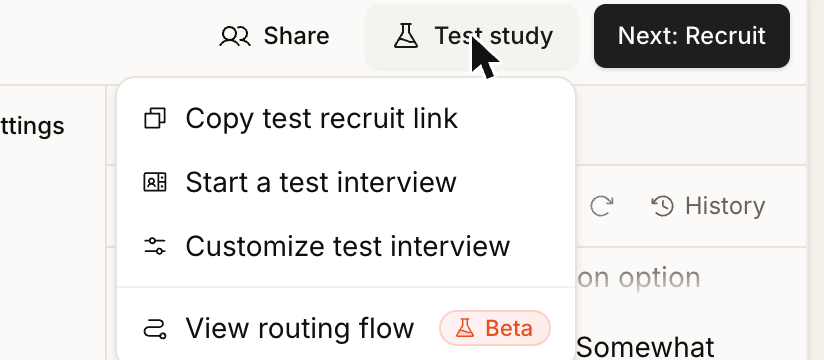
Open the testing menu
Open your study’s design page and choose Test study. The menu offers Start a test interview, Copy test recruit link, Customize test interview, and View routing flow.Choose the starting point
From the beginning: choose Start a test interview to open a test in a new tab. To involve colleagues, choose Copy test recruit link and share that link. Both run the ordinary participant experience with normal random stimulus selection. From one question, or with fixed conditions: choose Customize test interview, or open a question’s Question actions menu and select Test to open the same page with that question preselected. See Customize a test interview.Follow the participant journey
Follow the interview’s setup instructions, including camera, microphone, or screen sharing when requested. Answer the questions and check:- The question and stimulus are understandable together.
- Follow-up questions match your research objectives.
- Relevant questions appear and irrelevant branches are skipped in a full test.
- The interview language and localized assets are appropriate.
Make changes and retest
Return to the topic guide, edit the question or setting, and start a new test to check the change. Use a customized test for focused edits, then complete a full test from the beginning before launch.Customize a test interview
Test study → Customize test interview opens a setup page for a single test run. Nothing here changes your study design; the choices apply only to the test you are about to start.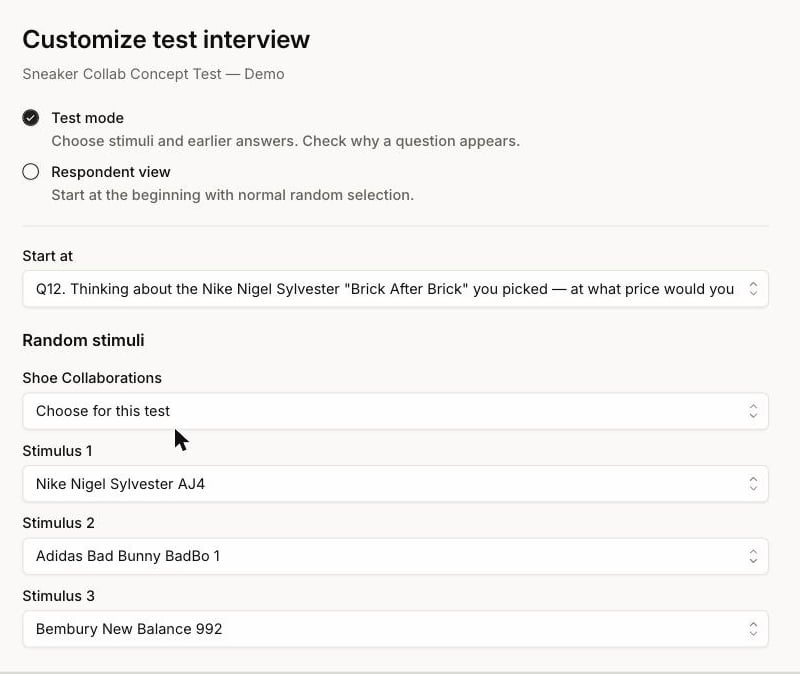
Choose test mode or respondent view
- Test mode lets you choose a starting question, pin stimuli, and supply earlier answers, and adds a panel that explains why each question is asked or skipped.
- Respondent view hides those controls and starts at the beginning with normal random selection. It is the same experience as Start a test interview.
Start at
Start at offers Beginning of the guide or any numbered question in the guide, including screener questions. Starting mid-guide means earlier questions are never asked, so their answers do not exist unless you supply them under Earlier answers.Random stimuli
This section appears only when the study has randomized stimuli, and shows one control per stimulus group, labeled with the group’s name.- Select randomly leaves the draw to the normal randomization and balancing logic.
- Choose for this test reveals one picker per stimulus position the interview assigns — Stimulus 1, Stimulus 2, and so on, up to the number of stimuli that study shows — each listing the group’s assets.
Earlier answers
This section appears only when the question you start at, or its section, has routing that depends on earlier answers. It lists each question the rules need, with Missing answer plus that question’s response options. These values feed routing evaluation only; the page states that they are not recorded answers. Leaving a value as Missing answer is a deliberate test case: it is how you check what happens to dependent questions when the source answer is absent. See Missing answers and participant properties.Follow a test in test mode
Start test interview in test mode opens the interview inside the app, alongside a Topic guide panel that explains the run.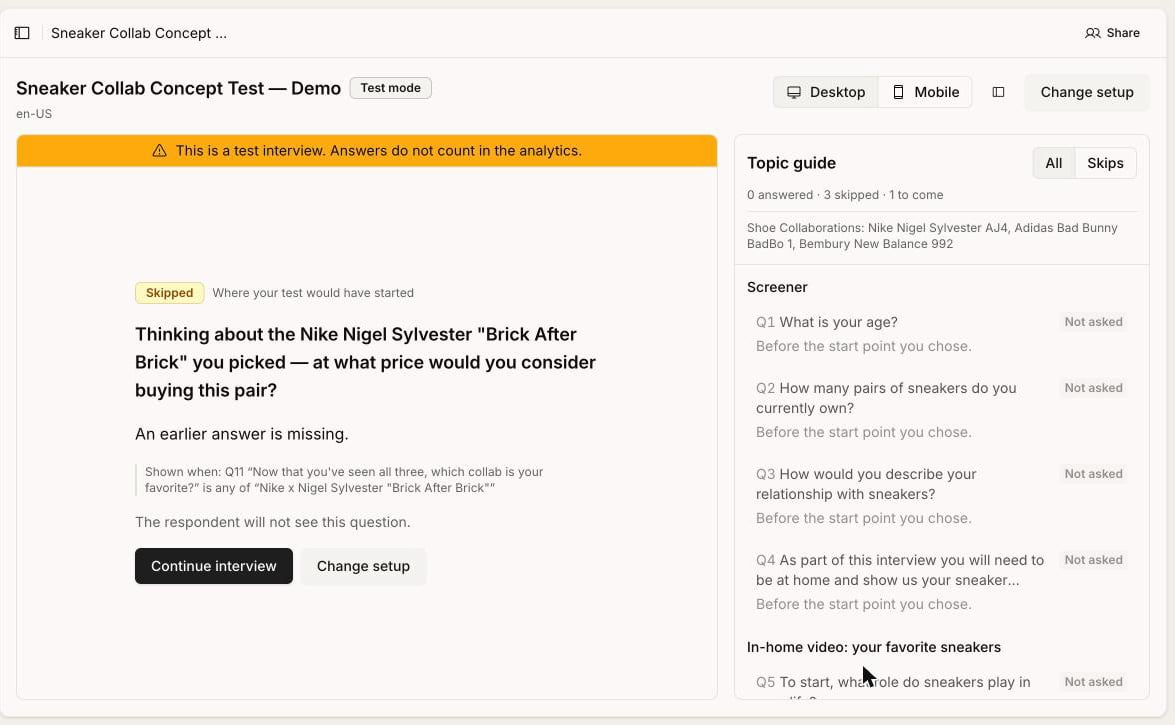
- Counters for how many questions are answered, skipped, and still to come.
- The stimuli assigned to this run, per group.
Statuses update as the interview progresses, and the counters at the top of the panel track how many questions have been answered so far.
Switch the panel to Skips to list only the skipped questions. Before anything is skipped it reads No skips yet.
Test mode evaluates routing rather than overriding it. If the question you start at is skipped by its own or its section’s rule, the run opens on a Skipped card that names the question, gives the reason, quotes the rule, and offers Continue interview to carry on to the next question that will be asked, or Change setup to supply the earlier answers that would make it appear.
Test diary entries and participant properties
If your study allows multiple completions or defines participant properties, a dialog opens before copying the link or starting the test.- Entry: choose the diary entry to simulate. The default is the first entry. Test later entries to check questions that depend on entry number.
- Participant properties: choose values for the properties your study defines, such as region or age group. Use different combinations to check property-based routing without uploading a participant CSV.
Before launching
Complete at least one full test from the beginning, in respondent view, and ask a colleague to review unclear instructions. Use customized tests to reach specific stimulus and routing combinations quickly, then confirm the whole path end to end. Check recruitment settings, response limits, and quota groups separately: tests bypass these limits during screening and do not establish that your recruitment setup will accept the intended sample. A test that returns to a qualified interview can still encounter the segment-capacity recheck before starting. For diary pauses and device restrictions, also review Detailed Topic Guide Settings.Need help? Contact support@conveo.ai.